Linguistic and Semantic Breakdown of "Dream Dream You"
The phrase "Dream Dream You" exemplifies a recursive linguistic structure, where repetition creates both semantic depth and phonetic resonance. Its grammatical construction defies conventional syntax, inviting analysis of its paradoxical nature—where the subject ("Dream") simultaneously acts as verb, object, and imperative. This breakdown examines its grammatical architecture, stylistic parallels in creative works, and practical applications in narrative and poetic composition.The phrase’s recursive loop—"Dream (verb) Dream (noun) You (object)"—disrupts linear interpretation, forcing the reader to oscillate between active and passive meanings. This ambiguity is not merely stylistic but functionally generative, as it mirrors psychological processes like lucid dreaming or self-reflective cognition. Below, the grammatical mechanics are dissected, followed by comparative examples and creative repurposing strategies.
Grammatical Structure and Recursive Paradox
The phrase "Dream Dream You" operates as a self-referential imperative with three interlocking components:
1. First "Dream" – A verb in the base form, functioning as a command ("Dream!").
2. Second "Dream" – A noun, objectifying the act of dreaming ("the Dream").
3. "You" – The implicit subject, addressed directly yet ambiguously (as both the dreamer and the dreamed).This structure creates a linguistic paradox akin to the "liar’s paradox" (e.g., "This statement is false"), where the phrase resists binary resolution. The repetition of "Dream" blurs the boundary between performative utterance (speech acts that alter reality, per J.L. Austin) and metalinguistic reflection (language describing itself). For instance:
As a command: "Dream (verb) the Dream (noun) that is You."
As a tautology: "The Dream (noun) is You (subject) dreaming (verb) it."Key Observations:
Anaphoric Reference: The second "Dream" echoes the first, creating a self-sustaining loop where meaning is generated through repetition rather than denotation.
Elliptical Syntax: The absence of auxiliary verbs ("do") or articles ("a") compresses the phrase into a minimalist imperative, amplifying its hypnotic quality.
Semantic Overload: The phrase simultaneously invokes desire (to dream), identity (the dream as "You"), and metaphysics (the dream as a self-contained universe).
Comparative Analysis of Recursive Phrases
Recursive repetition is a staple of avant-garde poetry, advertising slogans, and musical lyrics, where it serves to hypnotize, unify, or provoke. Below are three categories of recursive phrases, analyzed for their stylistic impact:1. Poetic and Literary Examples
Recursive phrases in poetry often exploit sound patterns (alliteration, assonance) to mimic the subject matter. Examples include:
E.E. Cummings’ "l(a" (1958):
> *"l(a
> leaf
> falls)"*
The fragmented structure forces the reader to reconstruct meaning through visual repetition, mirroring the cyclical nature of natural decay.
Bob Dylan’s "Subterranean Homesick Blues" (1965):
> "You don’t need a weatherman to know which way the wind blows."
The redundant phrasing ("which way") creates a folkloric rhythm, reinforcing the song’s theme of inevitability.
William S. Burroughs’ Cut-Up Technique:
Phrases like "The time has come, the walrus said" (repeated from Lewis Carroll) are sliced and reassembled to induce disorientation, a technique Burroughs applied to "Dream Journal" fragments.Stylistic Impact: These examples demonstrate how recursion can disrupt linearity, forcing the audience to engage actively with the text. In "Dream Dream You", the repetition simulates the recursive nature of dreams—where thoughts loop back on themselves.
2. Advertising and Branding
Recursive slogans leverage mnemonic devices and self-referential branding. Notable cases:
Nike’s "Just Do It" (1988):
The imperative "Do" is often repeated in variations ("Do more," "Do all"), creating a brand mantra that feels both personal and universal.
Coca-Cola’s "Open Happiness" (2009):
The phrase "Open" is recontextualized across campaigns, linking the act of opening a bottle to emotional states ("Open your heart").
Apple’s "Think Different" (1997):
The recursive command ("Think" + "Different") positions the audience as both the thinker and the thought, aligning with Apple’s identity as a disruptive force.Stylistic Impact: Recursive advertising phrases anchor brand identity by making the consumer an active participant in the loop. "Dream Dream You" could similarly function as a self-branding mantra for creative professionals or spiritual seekers.
3. Musical and Performative Repetition
In music, recursion often serves ritualistic or hypnotic purposes, as seen in:
The Beatles’ "Tomorrow Never Knows" (1966):
The repetitive vocal loops ("Turn off your mind, relax and float downstream") mimic the cyclical nature of meditation, aligning with the song’s psychedelic themes.
Radiohead’s "Pyramid Song" (2001):
The repetitive, ascending vocal harmonies ("I’m not afraid to die") create a spiral effect, symbolizing both fear and transcendence.
Hip-Hop’s Call-and-Response (e.g., Grandmaster Flash’s "The Message"):
Lines like "It’s like a jungle sometimes, it makes me wonder how I keep from going under" use internal repetition to emphasize struggle and resilience.Stylistic Impact: Musical recursion immerses the listener in a trance-like state, reinforcing themes of infinity, struggle, or liberation. "Dream Dream You" could be adapted into a lyrical refrain with a hypnotic, looping melody, amplifying its meditative potential.
Creative Repurposing of "Dream Dream You"
The phrase’s recursive ambiguity makes it versatile for narrative devices, mantras, and symbolic motifs. Below are three distinct scenarios demonstrating its adaptability:Scenario 1: As a Plot Device in Speculative Fiction
In a surrealist novel or sci-fi short story, "Dream Dream You" could serve as:
A Portal Mechanism: A character discovers a recursive dream layer where entering one dream triggers another, each iteration altering reality. The phrase becomes a password or incantation to navigate the layers (e.g., "To exit, you must Dream Dream You again").
A Psychological Trap: A villain uses the phrase to manipulate perception, making victims relive the same dream loop ("You are dreaming that you are dreaming that you are trapped").
A Prophecy: In a mythological setting, the phrase is an ancient incantation that allows the speaker to merge with their dreams, leading to either enlightenment or madness.Example Narrative Fragment:
> "The therapist’s voice echoed in the white room: ‘Dream Dream You.’ Lina obeyed, but the second ‘Dream’ wasn’t a command—it was a door. She stepped through, only to find herself back in the clinic, the clock ticking backward. ‘You’ve been here before,’ the doctor whispered. ‘This is the third time.’"
Scenario 2: As a Meditative or Spiritual Mantra
In mindfulness practices or lucid dreaming guides, the phrase can be reconfigured for self-reflection:
Lucid Dream Induction: Practitioners repeat "Dream Dream You" to separate conscious awareness from the dream state, reinforcing the idea that "You are the dreamer and the dreamed."
Therapeutic Affirmation: A therapist might use it to break negative thought loops by reframing anxiety as "You are dreaming your fear; now dream it differently."
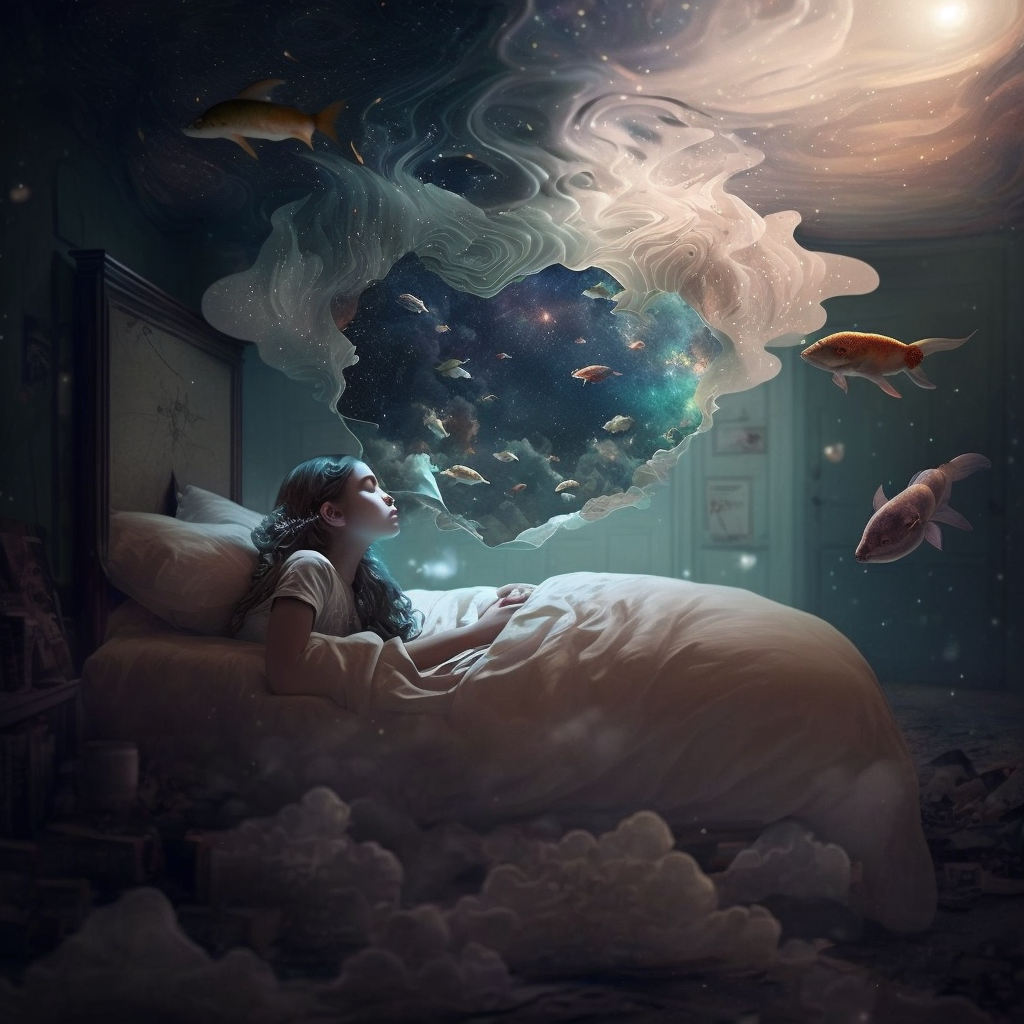
Sleep Paradox Meditation: A guided audio track could instruct listeners to visualize their dreams as recursive, using the phrase to transition between wakefulness and REM sleep.Example Meditation Script:
> "Close your eyes. Whisper: ‘Dream Dream You.’ Feel the first ‘Dream’ as your breath—inhale desire, exhale control. The second ‘Dream’ is the story unfolding. You are both the author and the character. Now, dream yourself awake."
Scenario 3: As a Title for a Creative Work
The phrase’s duality makes it ideal for titles that explore identity, artifice,
Artistic and Visual Representations of "Dream Dream You"
The phrase "Dream Dream You" encapsulates a recursive, self-reflexive paradox—where the act of dreaming becomes both the subject and the medium of perception. This ambiguity lends itself to rich artistic interpretation, where visual and kinetic representations can explore themes of infinite regression, subconscious fragmentation, and the fluidity between reality and illusion. Surrealist, cybernetic, and even minimalist traditions offer frameworks to materialize its layered meaning, while animation and mixed-media techniques can simulate the disorienting experience of nested dreams. Below, structured approaches detail how to translate this phrase into tangible art, from static compositions to dynamic sequences, while contextualizing it within broader artistic traditions.
Designing a Surrealist Painting with "Dream Dream You" as the Central Motif
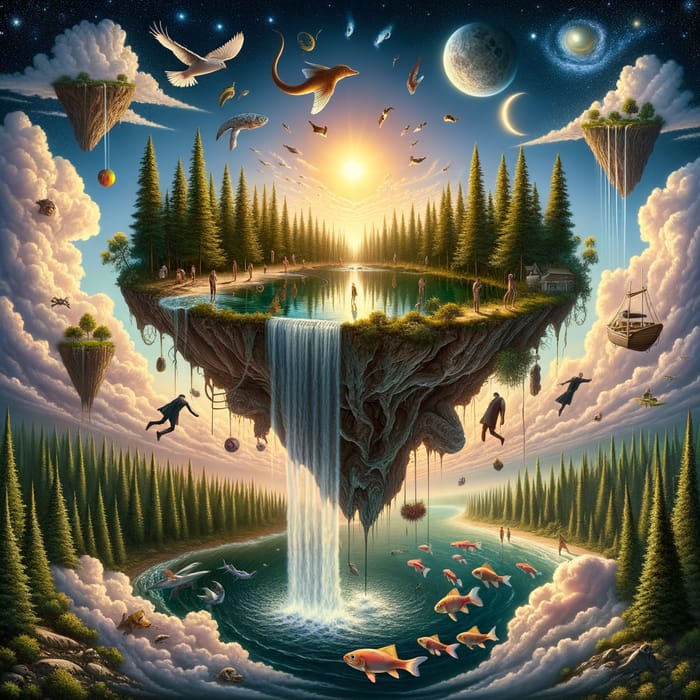
A surrealist painting centered on "Dream Dream You" should prioritize visual recursion, uncanny symbolism, and dissolving boundaries between observer and observed. The composition must evoke a sense of infinite loops—where figures, objects, or landscapes mirror or distort themselves, creating a hall of mirrors effect. Key elements include:
- Color Palette:
Primary: Deep ultramarine and burnt sienna for the background, suggesting a twilight or subconscious void.
Secondary: Iridescent teals and magentas for dreamlike figures, evoking the uncanny glow of half-remembered visions.
Accents: Neon pink and electric blue in geometric fractures (e.g., cracks in reality) to imply digital or psychic interference.
Contrast: High-contrast shadows (e.g., chiaroscuro) to emphasize the "dream within a dream" depth.- Symbolic Objects:
Recursive Mirrors: A series of convex and concave mirrors reflecting each other, with each reflection slightly distorted (e.g., a face in one mirror becomes a door in the next).
Floating Hands: Disembodied hands reaching toward the viewer, each holding a smaller version of the painting itself (like a Russian nesting doll of dreams).
Melting Clocks: Dali-esque clocks dripping into abstract shapes, but with clock faces showing different times (e.g., 3:33, 12:00, 6:66) to symbolize temporal disintegration.
Eyes in the Void: Giant, pupil-less eyes embedded in the canvas’s texture, staring back at the viewer from within the dream’s layers.- Composition Techniques:
Layered Transparency: Use glazing or digital compositing to create semi-transparent figures that bleed into the background.
Negative Space as a Character: The empty spaces between elements should feel active, as if they’re swallowing or birthing the dream.
Biomorphic Forms: Organic, amorphous shapes (e.g., tendrils, blobs) that suggest both growth and dissolution, avoiding rigid geometry.Technical Execution:
Medium: Oil on canvas with mixed-media collage (e.g., incorporating torn photographs of faces or architectural fragments).
Texture: Impasto techniques for tactile surfaces (e.g., thick paint for "dream barriers," smooth glazes for liquid-like transitions).
Lighting: Directional light sources (e.g., a single spotlight) to cast elongated shadows that imply depth but resist perspective logic.
Four Visual Styles and Their Interpretations of Ambiguity
The phrase "Dream Dream You" resists singular interpretation, making it adaptable to diverse artistic languages. Below are four distinct styles, each recontextualizing its ambiguity through formal and thematic choices.
The selection of style dictates whether the phrase is rendered as a trapdoor into the subconscious, a glitch in reality, a poetic metaphor, or a mechanical illusion—each approach reveals different facets of its recursive nature.
Cyberpunk Neon Surrealism
Thematic Focus: The dream as a hacked reality, where digital and organic merge. The phrase becomes a glitch in the matrix, a recursive loop in a simulated consciousness.
Visual Traits:
Lighting: Harsh neon grids (cyan, magenta) intersecting with organic bioluminescence (e.g., glowing veins in a figure’s arm).
Objects: Screens displaying fragmented code that reassembles into faces; robotic limbs with human skin.
Composition: Low-angle shots of towering holographic billboards advertising "dream subscriptions," with the viewer’s reflection warping in real-time.
Example Motif: A character’s iris scans a QR code, which dissolves into a portal—only for the portal to reflect the character’s own eye.- Watercolor Dream Logic
Thematic Focus: The ephemeral and emotional nature of dreams, where logic dissolves into fluid associations. The phrase becomes a stream-of-consciousness visual poem.
Visual Traits:
Color: Soft, blended hues (sap green, lavender, pale gold) with accidental bleeds mimicking ink stains.
Objects: Symbolic motifs like drowning clocks, floating keys, or a child’s drawing of a house that morphs into a face.
Composition: Loose, gestural brushwork with areas of deliberate smudging to suggest memory gaps.
Example Motif: A hand reaches into the painting’s wet edges, pulling out a smaller watercolor that depicts the same hand—but older, younger, or in a different pose.- Pixel Art Minimalism
Thematic Focus: The mechanical repetition of dreams, where recursion is literalized through digital sampling and low-resolution distortion.
Visual Traits:
Grid: 8-bit or 16-bit pixelation with blocky, jagged edges to emphasize artificiality.
Objects: Tiled patterns (e.g., a repeating dream journal page) that shift slightly with each iteration.
Color: Limited palette (e.g., 16 colors) with dithering to create depth, evoking retro gaming aesthetics.
Example Motif: A character walks toward the horizon, but each step replaces the previous one with a slightly corrupted version (e.g., pixels flicker, colors invert).- Abstract Expressionist Gesture
Thematic Focus: The physical act of dreaming as a bodily experience, where the phrase becomes a metaphor for creative subversion.
Visual Traits:
Texture: Thick, viscous paint applied with palette knives or fingers, creating tactile "dream scars."
Objects: Abstracted body parts (e.g., a floating eye, a mouth without a face) connected by energetic brushstrokes.
Color: High-contrast, emotionally charged (e.g., crimson and black for intensity, ochre and white for warmth).
Example Motif: A central void (the "dream") surrounded by explosive, radiating lines that imply both birth and collapse.
A short animated sequence triggered by "Dream Dream You" should simulate the nonlinear, disorienting experience of nested dreams. The following keyframes and transitions leverage morphing, temporal distortion, and recursive framing to create a sense of infinite regression.Narrative Structure:
The sequence begins with a static object or figure, which, upon hearing the phrase, dissolves into a dream state, only to re-emerge in a distorted version of the original space.
- Keyframes and Transitions:
| Time | Action | Technical Execution |
|---|
| 00:00 | Initial State: A closed eye (or a door, a book) in a neutral environment (e.g., a bedroom at dusk). | Use a matte painting for the background with subtle depth cues (e.g., warm lighting). |
| 00:02 | Trigger: The phrase "Dream Dream You" is spoken (off-screen or as text appearing). | Sound Design: A pitch-shifted voice or glitchy audio to disrupt reality. |
| 00:04 | Dissolution: The eye/door/book melts into a liquid state, revealing a mirror-like surface. | Effect: Fluid simulation (e.g., Blender’s liquid physics) with refraction shaders. |
| 00:06 | Recursive Reflection: The mirror shows a shrunken version of the original scene, but with one element altered (e.g., the eye now has teeth). | Technique: Planar tracking to composite the reflection with a slightly warped version of the original. |
| 00:08 | Transformation |
Philosophical and Existential Implications of "Dream Dream You": A Reevaluation of Perception and Agency
The phrase "Dream Dream You" transcends its lyrical or artistic surface to provoke profound philosophical inquiries into the nature of consciousness, reality, and human agency. It challenges foundational frameworks such as Cartesian dualism by dissolving the rigid boundaries between subjective experience and objective reality. The phrase also invites a critical examination of whether dreams constitute an autonomous realm of existence (solipsism) or actively shape the fabric of waking reality (phenomenology). Existentialist thought further intersects with this inquiry, as the phrase mirrors the existentialist preoccupation with free will, authenticity, and the individual’s capacity to define their own existence through perception and action. Below, a structured exploration dissects these implications, culminating in a flowchart that traces the phrase’s philosophical trajectory from perception to reality.
Challenging Cartesian Dualism: The Collapse of Mind-Body Separation
René Descartes’ res cogitans (thinking substance) and res extensa (extended substance) established a dualistic framework where mind and body operate as distinct entities, with consciousness as an immaterial observer of a material world. "Dream Dream You" disrupts this dichotomy by framing perception itself as a dynamic, iterative process—one where the dreamer and the dreamed are not static but co-constitutive. The phrase suggests that reality is not a passive backdrop but an active construction of the mind, blurring the line between inner experience and external existence.This challenge aligns with contemporary theories in enactive cognition and extended mind thesis, which propose that cognition is not confined to the brain but emerges from interactions between organism and environment. For instance, neuroscientific studies on lucid dreaming demonstrate how self-awareness within dreams can alter neural patterns, suggesting that the mind’s perception of reality is malleable. The phrase thus implies that the Cartesian "ghost in the machine" is not a spectator but a participant in the creation of its own world.
Solipsism vs. Phenomenology: Dreams as Autonomous or Co-Constructive Realities
The phrase "Dream Dream You" can be interpreted through two competing philosophical lenses: solipsism, which posits that only one’s own mind is sure to exist, and phenomenology, which emphasizes the lived experience as the primary constituent of reality. These interpretations diverge in their ontological claims but converge in their rejection of naive realism—the idea that perception directly mirrors an external world.Solipsistic Reading:
Under a solipsistic framework, the phrase suggests that dreams are the sole authentic reality, while waking life is a secondary or illusory construct. This aligns with Husserl’s epoché (bracketing of external reality) and Nietzsche’s perspectivism, where truth is a product of individual interpretation. For example, the Tibetan Bardo Thödol (Tibetan Book of the Dead) describes dreams as liminal states where the soul confronts its own projections, reinforcing the idea that perception is self-generated. However, solipsism risks reducing intersubjectivity to mere illusion, which contradicts the phrase’s implicit acknowledgment of shared human experience (e.g., collective dreaming in cultural narratives).
Phenomenological Reading:
A phenomenological interpretation, influenced by Merleau-Ponty’s embodied cognition, argues that dreams are not isolated from waking reality but actively shape it. Dreams serve as a pre-reflective layer of consciousness, where raw perceptions (e.g., emotions, sensations) precede structured thought. The phrase "Dream Dream You" thus becomes a call to recognize that waking identity is an extension of dream logic—habits, fears, and desires formed in sleep persist and structure daily life. Research in neurophenomenology supports this, showing how dream imagery (e.g., recurring motifs) correlates with waking personality traits (e.g., anxiety in nightmares).
Existentialist philosophy, particularly the works of Jean-Paul Sartre and Albert Camus, grapples with the tension between determinism and freedom. "Dream Dream You" resonates with existentialist themes by framing reality as a project—one where the individual is both the architect and inhabitant of their own narrative. Sartre’s notion of radical freedom ("L’existentialisme est un humanisme") finds an echo in the phrase, as it implies that perception (and thus reality) is not predetermined but actively chosen.Sartre’s Bad Faith and Dream Logic:
Sartre’s concept of bad faith—where individuals deceive themselves into believing they are passive recipients of circumstances—parallels the dreamer’s illusion of control. In dreams, the self often experiences agency without consequence (e.g., flying without effort), yet upon waking, this fluidity is constrained by societal norms. The phrase "Dream Dream You" thus becomes a critique of inauthentic living, urging the individual to reclaim their perceptual sovereignty. For example, in Nausea (1938), Sartre’s protagonist Roquentin describes his existence as a series of "unwilled encounters," but "Dream Dream You" reframes this as a call to will one’s encounters through conscious perception.
Camus’ Absurd and the Dreamer’s Rebellion:
Camus’ absurd—the conflict between the human desire for meaning and a silent universe—manifests in the dreamer’s struggle to reconcile lucid awareness with the dream’s illogic. The phrase suggests that embracing the absurd (i.e., accepting that reality is a dream-like construction) is not nihilistic but liberating. In The Myth of Sisyphus (1942), Camus argues that rebellion against predetermined narratives is the essence of freedom. Similarly, "Dream Dream You" implies that by acknowledging the dream-like nature of existence, one gains the power to rewrite its rules—mirroring Camus’ lucid hero who defies fate through sheer will.
Flowchart: From Perception to Reality Through "Dream Dream You"
The philosophical implications of "Dream Dream You" can be mapped as a dynamic process where perception, identity, agency, and reality are interdependent. Below is a structured flowchart outlining this trajectory:| Philosophical Flowchart: "Dream Dream You" |
| Perception |
→ |
Identity |
→ |
- Raw Sensory Input: Dreams and waking states provide unfiltered perceptual data (e.g., synesthesia in dreams).
- Constructed Reality: Perception is shaped by cognitive schemas (e.g., cultural narratives, personal trauma).
- Liminal States: Hypnagogic/hypnopompic experiences blur dream/waking boundaries (e.g., sleep paralysis).
|
|
- Fluid Self: Identity is not fixed but emerges from perceptual loops (e.g., "dream ego" vs. waking self).
- Authentic vs. Inauthentic: Sartre’s bad faith applies—identity may be imposed by societal dreams (e.g., career expectations).
- Collective Identity: Shared cultural "dreams" (e.g., utopias, nightmares) shape group identity (e.g., national myths).
|
|
→ |
|
→ |
|
|
Agency |
→ |
|
|
- Lucid Agency: Recognizing the dream-like nature of reality grants control (e.g., lucid dreaming techniques).
- Existential Choice: Camus’ rebellion—acting despite the absurdity of perception (e.g., artistic creation as defiance).
- Neuroplasticity: Repeated perceptual patterns (e.g., meditation, therapy) rewire identity and agency (e.g., cognitive behavioral therapy).
|
|
<
Practical Applications in Creative Industries
The phrase "Dream Dream You" transcends abstract interpretation, offering a versatile framework for branding, creative facilitation, and experiential design across industries. Its cyclical structure—emphasizing both aspiration (dream) and self-reflection (you)—aligns with modern consumer psychology, where personal agency and subconscious engagement drive engagement. Below are structured applications in wellness, media, education, and technology, demonstrating its adaptability as a generative tool for storytelling, product design, and interactive experiences.
Branding Slogan for a Wellness App
"Dream Dream You" serves as a foundational slogan for a wellness app by merging motivational messaging with psychological grounding. The phrase’s duality—inviting users to dream (set intentions) while anchoring them in you (self-awareness)—resonates with trends in mindfulness, habit-building, and digital self-care. Below are tagline variations and visual identity concepts tailored to different app personas.Tagline Variations by User Archetype:
For Beginners (Gentle Introduction):
"Dream Dream You: Start small. Dream bigger."
Visual: Soft gradients of lavender and sage green, with a minimalist icon of a sleeping figure morphing into a sunrise.- For High-Achievers (Performance Focus):
"Dream Dream You: Design your reality. Own your rest."
Visual: Geometric typography with a split-screen effect—one side showing a fragmented dream journal, the other a sleek productivity dashboard.
- For Therapeutic Use (Trauma-Informed Wellness):
"Dream Dream You: Reclaim your narrative. Rewrite your sleep."
Visual: A collage of dreamlike symbols (e.g., keys, bridges) dissolving into a serene moonlit landscape, with a subtle "safe space" border.
Visual Identity Sketches (Descriptive Breakdown):
1. App Icon:
A circular emblem featuring a stylized eye (symbolizing self-reflection) with a spiral inside, representing dream cycles. The spiral’s direction reverses when tapped, implying active participation.
Color Palette: Deep teal (#006D77) for trust, warm gold (#FFD700) for aspiration, and muted coral (#FF9B85) for energy.2. Onboarding Screen:
A "Dream Map" interactive feature where users drag and drop elements (e.g., clouds for anxiety, stars for goals) into a night-sky backdrop. The phrase "Dream Dream You" appears as a floating banner that glows when touched.3. Sleep Journal UI:
A split interface: The left side displays a "Dream Log" with AI-generated interpretations (e.g., "Your recurring storm dream may reflect unresolved conflict—try journaling before bed"), while the right side offers a "You" dashboard with mood tracking and micro-goals.
Podcast Episode Script Outline: "Dream Dream You" and Creativity
A 3-minute episode exploring the phrase’s role in artistic and professional creativity, featuring hypothetical experts: a neuropsychologist, a fashion designer, and a tech ethicist. The structure balances scientific insight with tangible creative strategies.Segment 1: Introduction (0:00–0:30)
Host: "Today, we unpack the phrase ‘Dream Dream You’—a loop of aspiration and self-awareness that’s reshaping how we approach creativity. Our guests will show us how this idea bridges psychology, design, and even AI."
Neuropsychologist: "The phrase taps into dual-process theory: the ‘dream’ activates our associative, imaginative brain (default mode network), while ‘you’ grounds it in autobiographical memory. This is why it’s so potent for ideation."Segment 2: Case Study – Fashion Design (0:30–1:30)
Fashion Designer: "I use ‘Dream Dream You’ in two phases: First, clients sketch unrealistic dreams (e.g., ‘a gown that floats like a memory’). Then, we deconstruct it into wearable elements—you becomes the bridge. For example, a client’s dream of ‘liquid silk’ led to a dress with 3D-printed, water-responsive fabric."
Visual Aid: Description of a mood board with a surreal landscape (dream) adjacent to a technical sketch (you).Segment 3: Ethical Tech Applications (1:30–2:30)
Tech Ethicist: "Algorithmic creativity tools often lack this ‘you’ component. For instance, AI-generated art platforms could integrate personalized constraints—like a user’s past sketches—to ensure outputs feel authentic. ‘Dream Dream You’ could be a prompt: ‘Generate a logo, but anchor it in my childhood symbolism.’"
Example: A hypothetical app where users input a "dream" (e.g., "a cyberpunk cathedral") and a "you" constraint (e.g., "must include my grandmother’s lace patterns").Segment 4: Listener Challenge (2:30–3:00)
Host: "This week, try this: Write down a wild dream (no limits), then ask: How does this reflect ‘me’ right now? Share your ‘you’ insights with us."
Neuropsychologist: "This exercise trains metacognition—the ability to think about your thinking—which is critical for creative breakthroughs."
Workshop Activity: Generating Personal "Dream Manifestos"
A 60-minute interactive workshop where participants craft a personal manifesto using "Dream Dream You" as a scaffold. The activity blends narrative therapy techniques with design thinking to externalize aspirations.Step-by-Step Instructions:
1. Priming (10 mins):
Prompt: "Close your eyes. Imagine your ideal future in three sensory details (e.g., the smell of rain, a sound, a texture). Now, ask: What ‘dream’ does this represent? How does it relate to ‘you’?""
Tool: Provide index cards and markers. Play ambient soundscapes (e.g., ocean waves) to trigger recall.2. Dual-Column Mapping (20 mins):
Divide a large sheet into two columns:
Column 1 (Dream): List abstract desires (e.g., "to feel untouchable," "a world without borders").
Column 2 (You): Identify personal traits, fears, or experiences that connect to each dream (e.g., "My fear of abandonment makes me crave safety—so my ‘untouchable’ dream is about self-trust").
Example Output:| Dream | You |
|---|
| A library of forgotten books | My grandmother’s stories taught me that knowledge is alive. |
Guide participants to refine one dream into a SMART (Specific, Measurable, Actionable) goal tied to their "you" identity.
Template:
> "I, [Name], dream of [abstract goal]. This reflects my [core value/identity], so I will [specific action] by [date], measured by [outcome]."4. Visualization (10 mins):
Create a collage combining:
A symbol of the dream (e.g., a key for unlocking potential).
A photo representing "you" (e.g., a childhood picture).
A handwritten phrase from the manifesto.
Optional: Use a digital tool like Canva with pre-loaded dream-themed templates.Debrief Questions (Optional Group Share):
Which "you" insight surprised you?
How does this manifesto differ from traditional goal-setting?
Cross-Industry Use Cases Table
The following table outlines how "Dream Dream You" can be adapted across sectors, with examples of output and methods.
| Industry |
Use Case |
Example Output |
Tools/Methods |
|---|
| Music Production |
Lyric Writing Prompt |
*"Dream Dream You (Verse 1):I dreamed in neon, you in grayscale— My hands were fire, yours were chains. Chorus: Dream dream you, but wake up mine."
|
- Tool: AI lyric generators (e.g., Sudowrite) with "dream-you" constraints.
- Method: Free-write a song where each verse alternates between "dream" imagery and "you" (personal metaphor).
Technological and Futuristic Interpretations of "Dream Dream You"
The phrase "Dream Dream You" transcends its poetic and philosophical dimensions to intersect with emerging technologies, redefining how artificial intelligence, virtual reality, and quantum computing could manipulate, simulate, or even encode the boundaries of human perception. Its recursive structure—where the verb "dream" both acts upon the subject (you) and is itself an object of dreaming—offers a framework for systems that generate, share, or quantify subjective experience. Below, this exploration examines AI-driven dream synthesis, immersive VR design, quantum parallelism in dream states, and the reimagining of sci-fi tropes through the lens of this phrase.
AI-Generated Personalized Dream Narratives
A hypothetical AI system trained on "Dream Dream You" would function as a neuro-linguistic dream architect, synthesizing narratives tailored to an individual’s psychological profile, emotional state, and subconscious patterns. The system would operate on a multi-modal input/output pipeline, integrating:- Input Parameters:
- Biometric Data: EEG/fMRI scans to detect sleep cycles, REM phases, and neural activation patterns (e.g., delta waves for deep sleep vs. theta waves for lucid dreaming).
- Psychometric Profiles: MBTI, Big Five Inventory, or trauma-informed assessments to align dream themes with personality archetypes (e.g., an INTJ might receive dreams emphasizing logic puzzles, while an ESFP might experience social simulations).
- Real-Time Emotional Feedback: Wearable devices (e.g., Empatica E4) tracking galvanic skin response, heart rate variability, and cortisol levels to dynamically adjust dream intensity.
- Explicit User Prompts: Text or voice inputs specifying desired themes (e.g., "Dream Dream You: a library where books rewrite themselves").
- Output Parameters:
- Hypnagogic Audio: Binaural beats and ASMR-inspired soundscapes to induce dream states (e.g., a 4.5Hz theta wave stimulus paired with whispered narratives).
- Visual Storyboards: Procedurally generated dream sequences using GANs (Generative Adversarial Networks) trained on surrealist art and dream journals (e.g., Salvador Dalí’s The Persistence of Memory remixed with user-specific symbols).
- Tactile Feedback: Haptic gloves or pressure-sensitive mattresses simulating dream physics (e.g., floating sensations via levitation illusions or resistance when "touching" dream objects).
- Olfactory Triggers: Scent diffusion systems emitting phantoms (e.g., lavender for calm, burnt sugar for nostalgia) to anchor memories post-dream.
Example System: "Oneironaut" (Greek: oneiros = dream, nautes = sailor) could deploy a reinforcement learning model to refine dream coherence over time, rewarding users for reporting "immersive" or "emotionally resonant" experiences. Ethical safeguards would include:
- Consent Protocols: Opt-in for dream recording/storage, with anonymization for research.
- Trauma Mitigation: AI filters to avoid triggering PTSD or anxiety (e.g., avoiding nightmares for users with documented trauma).
- Grounding Mechanisms: Post-dream debriefs with a therapist-AI hybrid to distinguish dream logic from reality.
VR Experiences Inspired by "Dream Dream You"
Virtual reality platforms leveraging "Dream Dream You" would prioritize sensory fusion to dissolve the user’s awareness of the physical body, creating a liminal space between wakefulness and sleep. Key design principles include:- Sensory Design Matrix: | Sensory Modality |
Technological Implementation |
Example Application |
|---|
| Visual |
Foveated rendering + retinal projection (e.g., Magic Leap 2) |
Objects morph based on gaze duration (e.g., a door transforms into a face when stared at for 5 seconds). |
| Haptic |
Ultrasonic haptics (e.g., Ultrahaptics) + pressure suits |
Simulating weightlessness or "dream paralysis" (body immobility with phantom sensations). |
| Olfactory |
Microfluidic scent emitters (e.g., OVR Technology) |
Triggering episodic memories via smell (e.g., baking bread scent evoking childhood dreams). |
| Auditory |
Binaural audio + bone conduction |
Whispered dialogue that only the user hears, mimicking internal monologue. |
| Thermal |
Peltier modules in VR gloves/masks |
Simulating fever dreams (warmth) or icy lucidity (coolness). |
- Narrative Structures:
- Procedural Dream Logic: Environments where physics defy expectation (e.g., gravity reverses when the user blinks).
- Shared Dream Spaces: Multiplayer VR where users’ subconscious themes merge (e.g., one user’s "floating library" becomes another’s "underwater city").
- Lucid Dream Triggers: In-game cues (e.g., reading a word like "DREAM" in the environment) to prompt self-awareness within the dream.
Case Study: "Morpheus Labs" (hypothetical) developed "The Recursive Hallway", a VR experience where users navigate an infinite corridor whose walls shift based on their physiological stress levels. High cortisol triggers surreal distortions (e.g., doors appearing where there were none), while low stress reveals hidden paths. The experience concludes with the user "waking up" in a digital mirror that reflects their dream journal entries.
Quantum Encoding of Parallel Dream States
The recursive nature of "Dream Dream You" lends itself to a quantum computational thought experiment: Could dream states be represented as superpositions of narrative possibilities, explored via quantum parallelism? This would require:- Quantum Dream State Model:
- Qubit Encoding: Each dream element (characters, settings, emotions) is mapped to a qubit, where |0⟩ = "realistic," |1⟩ = "surreal," and superpositions (α|0⟩ + β|1⟩) represent ambiguous states.
- Entanglement: Dream threads are entangled such that altering one element (e.g., a character’s face) instantaneously affects related elements (e.g., their dialogue style).
- Decoherence as Awakening: The collapse of the quantum state into a classical narrative mirrors the transition from dreaming to waking.
- Thought Experiment:
A quantum computer simulates "Dream Dream You" by:
1. Initializing a dream seed (e.g., "a red door") as a superposition of possible interpretations.
2. Applying unitary operations to explore parallel dream branches (e.g., the door leads to a garden in one state, a void in another).
3. Measuring the user’s neural response (via EEG) to collapse the superposition into a coherent dream.
4. Iterating the process in real-time, allowing the user to "steer" the dream by influencing qubit states via biofeedback. Challenges:
- Scalability: Current quantum computers (e.g., IBM’s 433-qubit Osprey) lack the qubits for complex dreams.
- Interpretation: Deciphering quantum dream states would require a quantum natural language processing (QNLP) model, which does not yet exist.
- Ethics: Quantum dream exploration could raise questions about determinism vs. free will—if dreams are quantum superpositions, does the act of dreaming "choose" a reality?
Analogy: This approach mirrors David Deutsch’s quantum multiverse theory, where each dream branch represents a parallel universe of narrative possibilities.
Rewriting Sci-Fi Tropes with "Dream Dream You" as the Core
The phrase reframes classic sci-fi motifs by centering self-generated perception and recursive consciousness. Below are three tropes reimagined through its lens:- Shared Dreams as Consciousness Networks:
"In the Dream Dream You Collective, individuals don’t share dreams—they share the act of dreaming itself. A hacker in Tokyo might find their lucid dream bleeding into a stranger’s nightmare in Mumbai, not because of a virus, but because their subconscious frequencies aligned. The Collective’s servers don’t transmit data; they transmit d"Dream Dream You" ultimately functions as a threshold between the conscious and the subconscious, a linguistic bridge that collapses the distance between creator and creation. Whether deployed as a mantra for self-discovery, a motif in cyberpunk storytelling, or an algorithmic prompt for AI-generated dreams, its power lies in its ambiguity—a quality that demands active engagement from both interpreter and observer. As cultures, technologies, and philosophies continue to evolve, the phrase remains a malleable lens through which to examine the fluid nature of reality itself. Its legacy is not in fixed meaning but in the endless conversations it provokes, urging us to question: if we dream the dream, who—or what—dreams us back?
|

Leave a Comment
Comments are moderated before appearing. The data you submit is processed according to the Privacy Policy of Staging Shopify Treasuretrails.